
By Linda Vernon
“Yes, we’ve cut the maternal mortality rate in half, but far too many women are still denied critical access to reproductive healthcare and safe childbirth, and laws don’t count for much if they’re not enforced. Rights have to exist in practice — not just on paper. Laws have to be backed up with resources and political will. And deep-seated cultural codes, religious beliefs and structural biases have to be changed.”
-Hilary Clinton
Dyrda, L. & Rechtoris, M. (2016). 8 Hilary Clinton quotes on healthcare – “I want you to understand why I am fighting so hard for the Affordable Care Act’. Becker’s Hospital Review. Retrieved online from https://www.beckershospitalreview.com/hospital-management-administration/8-hillary-clinton-quotes-on-healthcare-i-want-you-to-understand-why-i-am-fighting-so-hard-for-the-affordable-care-act.html.
Maternal and reproductive health are global health issues of concern in many parts of the developing world. Maternal health issues such as high maternal mortality rates are found in countries such as Afghanistan. Many women in the developing world are currently suffering and dying from conditions that are avoidable in developed countries and deal with preventable complications during pregnancy and childbirth.
Risk Factors
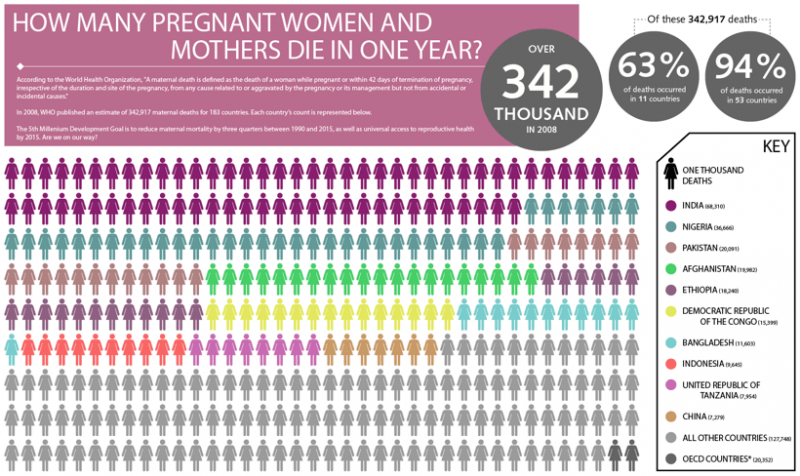
Some key risk factors attributed to high maternal mortality rates and reproductive health issues in the developing world are:
- Birth attendants are not properly trained: Without the proper skill level needed to act quickly and efficiently in instances of emergency, the chances of survival for mother and child significantly decrease. Afghanistan does not require any licensing or registry of midwives, meaning there is no set standard of the quality of care provided by these birth attendants. Of the estimated 1,573,000 pregnancies in Afghanistan in 2012, only about 1,085,000 or 2/3 had skilled birth attendants present at childbirth (United, 2014). The country only has about 3.2 nurses or midwives per 10,000 people, making access to health care that much more difficult (United, 2014).
- Lack of medicines and proper equipment: When medical emergencies occur during childbirth in developing countries such as Afghanistan, the lack of access to the life-saving medicines and medical equipment available in the first world puts women at risk for fatal complications.
- Completely natural birthing process: Afghanistan is a country where there is widespread belief that the childbirth process should occur without interference of medicine or other medical resources, though they may be necessary to save the mother and/or child’s life in case of an emergency.
- Scarce or lack of availability of birth control and family planning resources: A lack of access to birth control causes unwanted and unplanned pregnancies, leading to suboptimal pregnancy conditions that can put both mother and child at risk. Family planning resources are also scarce in Afghanistan, which means that women are less educated in complications that can arise during pregnancy and childbirth.
- Lack of infrastructure (Rosenblatt, 2011): In rural areas of developing countries, there is little infrastructure and services can be located several miles away. This can make it difficult for poor women to access health care services during pregnancy. Without proper health care, pregnant women are more prone to developing preventable conditions because of a lack of education and medical attention.
- Poverty and conflict-prone countries: With high levels of poverty in Afghanistan, access to medical services, medications, and modern technology are scarce resources that attribute to high levels of maternal mortality. Afghanistan has also suffered from political turmoil, with the country being involved in various conflicts with countries such as the US, reducing the availability of resources for maternal health.
Cost
High levels of maternal mortality increase the burden of disease on Afghanistan. Some of the costs associated with maternal mortality are seen in the following ways:
- High infant and child mortality – “children who have lost their mothers are up to ten times more likely to die prematurely than those who have not” (Raja, 2014, pg.14). This causes a double burden on Afghanistan because infants and children are both at increased risk of death with high levels of maternal mortality, when the mothers are no longer alive to take proper care of their children.
- Loss of productivity – women of child-bearing age are also at prime working age. Losing women to pregnancy and childbirth complications lowers the productivity of the country due to the loss of valuable members of the workforce
- Medical spending – 73.8% of healthcare spending is out-of-pocket in Afghanistan (World, 2015). High levels of poverty in Afghanistan mean that many women are unable to access the proper healthcare services due to cost, in addition to previously identified barriers to medical care.
Existing Challenges
In developing countries, women are often forced to give birth at home without the proper supervision or medical training of those assisting in the birthing process. It is estimated that 1 in 5 pregnancies are unplanned (Shapiro, 2010), which can lead to poor maternal health during pregnancy, especially if the mother is a teenager or has little to no education. Many people in the developing world also do not have access to a vehicle and may live too far or be too poor to obtain medical services; ambulances may not exist and therefore are unable to bring women to a hospital in case of emergency.
There are also many societal beliefs that play part in contributing to the reproductive health of women, such as the belief held in some countries that female genital mutilation will increase femininity and modesty (World Health, 2018). Not only is this practice harmful and completely unnecessary but it can cause serious harm or death of the child and can lead to childbirth complications in the future.
Cultural factors play a large role in the maternal health of the expectant mother. In Afghanistan, women are not usually involved in decision-making, including decisions about their own health. These decisions are made by husbands and mothers-in-law, and a male caretaker is usually used to accompany the expectance mother to all medical care appointments and for consent of any medical procedures.
It can be difficult to convince women in other countries to use birth control when it is available, because they view it as a western idea that is being imposed upon them (Shapiro, 2010). Many pregnancies are not only unplanned but also unwanted, so the introduction and use of birth control is very important in improving reproductive health in women across the globe, as well as maternal health by preventing pregnancies and reducing the chances of complications during pregnancy and childbirth. Without access to proper family planning resources, women are prone to have many pregnancies from the time they marry at a young age, to the time that they are no longer able to conceive, in their late 40’s or 50’s. Increasing the time span for pregnancy also increases the risk of maternal mortality related to pregnancy and childbirth complications.
Key Players and How They Help the Fight on Maternal Mortality in Afghanistan
Afghan Midwives Association (AMA)
Goals: To serve as a national, regional, and international model for the midwifery profession and to become a partner of choice in movements dedicated to women, pregnant mothers, newborns and families.
Mission: The AMA serves as an organization that promotes and supports midwifery as a distinct profession in Afghanistan; they advocate policy implementation to provide high quality midwifery services in accordance with the International Confederation of Midwives code of ethics and core competencies to improve the health and wellbeing of the women, pregnant mothers, infants and families in Afghanistan (Afghan, 2019).
The AMA is an association that works to improve women’s health nationally, promote and strengthen the midwifery profession, and promote and support law reforms on matters affecting midwives, mothers, and newborns. By providing formal education that adheres to the International Confederation for Midwifery code of ethics and core competencies, the organization can improve the care received by mothers during the childbearing cycle.
This will help to reduce maternal mortality in Afghanistan because the AMA is working to promote the education and safety practices of the midwives who serve women in the childbearing cycle.
Global Fund for Women
Goals: To win rights for women’s equality; to increase gender equality in education, work, and representation; to protect women from violence and to give women sexual and reproductive rights.
Mission: To work for a world where every woman and girl can realize and enjoy her human rights (Global, 2019).
This organization funds and advocates for laws and policies that address the needs of women by providing affordable, accessible, and high-quality health services. They work to empower women to challenge the status quo and demand better options. They work with existing women’s groups who advocate for women’s rights to safe and legal abortion, increase access to sex education, services and rights, as well as advocating for sexual and health rights for the transgender community. They also fund efforts to address gender-based violence, economic justice and leadership.
This relates to the issue of maternal mortality because providing affordable, accessible and high-quality health care is one of the primary ways to reduce the risk of maternal mortality. The risk of mortality is also reduced when women have access to safe and legal abortion services for unwanted and unsafe pregnancies.
Women for Afghan Women
Goals: To protect women and children who have endured human rights violations, including forced and underage marriage, rape, forced prostitution, unlawful imprisonment, and barred access to education and employment (Women, 2019).
Mission: To empower women and girls, to build a nation of advocates and allies for women’s rights, and to transform cultural norms of violence and oppression into norms of peace and equality (Women, 2019).
They have 32 centers and programs in Afghanistan that have directly supported over 33,000 Afghan women and children who have suffered human rights violations and trained over 333,000 women and men on women’s rights. They have established a Family Guidance Center that helps to bridge gaps in the social and legal systems of Afghanistan, to help change cultural norms that perpetuate violence. They offer refugee assistance, legal aid, mediation, emergency medical care, long-term protective shelters for women and children, and extensive human rights training. The organization hires locally so that there is a deep understanding and sensitivity to local culture, traditions, customs and challenges.
These programs help empower women and girls, and help prevent forced marriages and prostitution, leading to fewer unwanted pregnancies and lowering the maternal mortality rates by improving conditions for women and girls.
Future Opportunities
By implementing laws and regulations related to the midwifery practice, as well as implementing proper education and licensure requirements for midwives, maternal mortality rates in Afghanistan can rise significantly. This would ensure that skilled birth attendants are present to help mothers during childbirth and increase response rates in times of emergency. The Afghan Midwives Association provides education for midwives and is currently working to implement regulations that will improve life expectancy of mothers and infants in Afghanistan.
The Global Fund for Women focuses on providing education and helping women win equality rights in Afghanistan. By obtaining equality rights, the women of Afghanistan will be empowered to make decisions about their own health, including access to family planning resources. Education can help promote changes in cultural norms, to help women understand their rights and how to take control over their body and reproductive rights. By empowering women to speak up about decisions regarding their own bodies, the maternal mortality rates will decrease with an increase in planned pregnancies.
References
Afghan Midwives Association. (2019). Retrieved online from https://afghanmidwives.org/ (Links to an external site.)Links to an external site.
Bustreo, F. (2015). Promoting health through the life-course: Top ten issues for women’s health. World Health Organization. Retrieved online from https://www.who.int/life-course/news/commentaries/2015-intl-womens-day/en/ (Links to an external site.)Links to an external site..
Fathalla, M. (1997). Issues in Reproductive Health: Health and being a woman. United Nations. Retrieved online from http://www.un.org/womenwatch/daw/csw/issues.htm/ (Links to an external site.)Links to an external site..
Global Fund for Women. (2019). Retrieved online from https://www.globalfundforwomen.org/ (Links to an external site.)Links to an external site.
Nour, N.M. (2008). An Introduction to Global Women’s Health. Reviews in Obstetrics & Gynecology, 1(1): 33 – 37. Retrieved online from https://www.ncbi.nlm.nih.gov/pmc/articles/PMC2492587/pdf/RIOG01001_0033.pdf (Links to an external site.)Links to an external site.
Raja, F. (2014). Socio-Demographic and Economic Survey: Maternal Mortality – Provinces of Kabul, Bamiyan, Daykundi, Ghor, Kapisa and Parwan. Retrieved online from https://afghanistan.unfpa.org/sites/default/files/pub-pdf/Maternal%20Mortality%204%20web_0.pdf.
Skolnik, R. (2017). Global Health 101: Essential Public Health, 3rd Edition. Jones & Bartlett Learning: Burlington, MA.
United Nations Population Fund. (2014). Afghanistan: The State of the World’s Midwifery 2014. Retrieved online from https://www.unfpa.org/news/midwives-deployed-remote-afghanistan-lower-maternal-death-rate
Women for Afghan Women. (2019). Retrieved online from https://womenforafghanwomen.org/ (Links to an external site.)Links to an external site.
World Health Organization. (2015). Eastern Mediterranean Region: Framework for health information systems and core indicators for monitoring health situation and health system performance. Retrieved online from http://applications.emro.who.int/dsaf/EMROPUB_2015_EN_1904.pdf?ua=1. .
World Health Organization. (2018). Female genital mutilation. World Health Organization. Retreived online from https://www.who.int/news-room/fact-sheets/detail/female-genital-mutilation (Links to an external site.)Links to an external site..
Videos
Rosenblatt, M. (2011). “Michael Rosenblatt at TEDMED 2011”. TEDMED. Retrieved online from https://www.youtube.com/watch?time_continue=204&v=Fj6whvw6H5k (Links to an external site.)Links to an external site.
Shapiro, D.S. (2010). “The Edge of Joy”. ViewChange.org: Stories Powering Progress. Retrieved online from http://www.viewchange.org/videos/the-edge-of-joy (Links to an external site.)Links to an external site. .addEventLi
 Maternal and Reproductive Health